

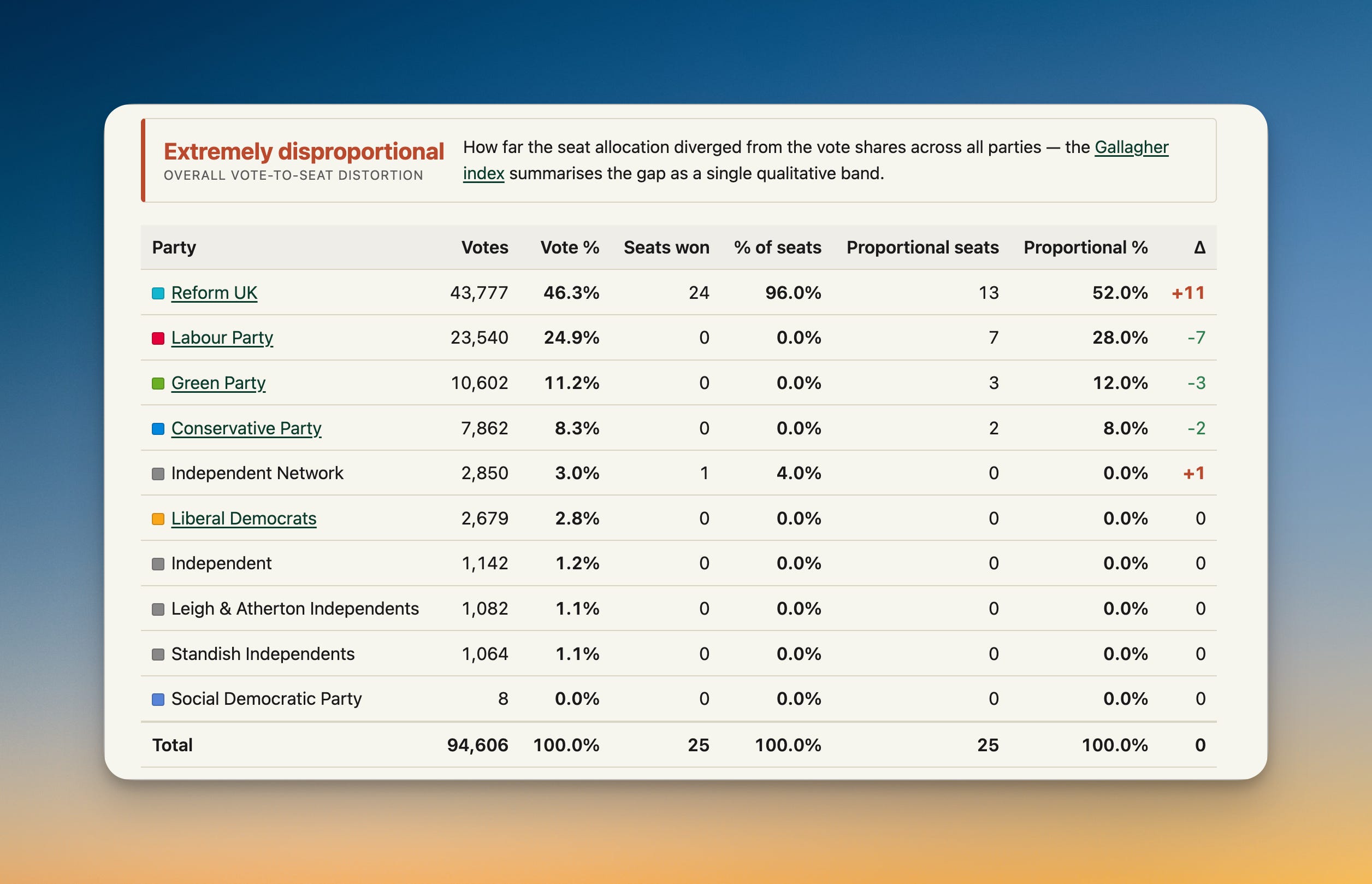
What the Makerfield by-election really tells us about Britain’s broken voting system
Andy Burnham is the most popular politician in Britain. According to YouGov, 35 per cent of people have a positive opinion of him — nearly twice that of Sir Keir Starmer. And yet, as the Makerfield by-election approaches on 18 June, nobody can confidently say he will win it.
That is not a story about Burnham, or about Starmer, or even about Labour. It is a story about a voting system that asks a country with five-party politics to express its preferences with a single, blunt “X”.
The maths of Makerfield
Makerfield has elected a Labour MP at every election since 1983. Labour’s Josh Simons won the seat in 2024 on 45.2 per cent, Reform UK on 31.8. In the local elections on 7 May 2026, Reform won every single ward.
Into this, Labour is sending its best player. Survation found that with Burnham as the candidate, Labour has a 67 per cent chance of winning. Without him, that chance is essentially zero. Sir John Curtice put it more bluntly: “less than 5 per cent” with anyone else.
Think about what that sentence means. The democratic outcome in a town of 76,000 voters depends not on what those voters believe, but on whether one particular celebrity politician is willing to drive up the M62.
Vote-splitting on both flanks
Makerfield matters because the splitting is happening on both sides at once.
On the right, Restore Britain, Rupert Lowe’s breakaway from Reform, is polling 5–6 per cent nationally; Find Out Now polling, commissioned by Restore itself, shows Reform’s vote dropping from 25 to 21 per cent when Restore is on the ballot. Add Advance UK, UKIP and the rump Conservative vote, and the right is now genuinely fractured — as the left has been for years.
On the left, the Greens are not standing aside. After winning Gorton and Denton in February with 41 per cent and a 33-point swing from Labour, Zack Polanski’s party is selecting a Makerfield candidate. Caroline Lucas has called on them to “put country before party” and give Burnham a clear run; the party’s answer, in effect, is that under first-past-the-post every party is forced to be selfish.
She is right, and so are they. That is the bug.
The plausible result on 18 June is a winner on something like 35–40 per cent of the vote, with 60–65 per cent of the constituency having voted for somebody else. We will call that a mandate. It is not one.
A system designed in 1884
Britain did not choose first past the post. Lord Salisbury did, in private, in 1884.
Negotiating with Gladstone over the price of expanding the working-class franchise, Salisbury insisted on carving England into hundreds of new single-member constituencies. On the question of how minority opinion would be represented, he wrote on the draft, in his own hand: “Minorities not to be directly represented.” The Redistribution of Seats Act 1885 made single-mark plurality the British default.
The system as we now use it dates from 1950 — younger than the NHS, and built on voting theory that was already a century out of date when Parliament settled on it.
We have learned a lot in 140 years. None of it is in our ballot box.
What Burnham’s bid actually proves
Look at the arithmetic. In a constituency that has voted Labour for forty years, with the country’s most popular politician on the ballot, the broadly progressive vote (Labour + Green + Lib Dem) is comfortably larger than the broadly right-wing vote (Reform + Restore + Conservative). And the seat can still go to a candidate the majority did not want.
That is not bad luck. It is what first-past-the-post does, by design, whenever there are more than two serious choices on offer.
Burnham himself has publicly backed proportional representation — a position he reached after winning the Manchester mayoralty under a preferential ballot that Conservatives later abolished. Sir Keir Starmer’s view, in effect, is that PR’s time has not come.
So Britain’s most prominent Labour advocate of electoral reform now has to win a single-mark-plurality seat, in order to lead a party whose leadership rejects his view, so that he might one day be in a position to do something about the system that, in the meantime, may well be what stops him getting there at all.
A grown-up next step
Disclosure first: I advise Citizen Sector, which is part of the coalition asking Parliament for this Commission, and I donate to Make Votes Matter. The argument that follows is one I have a stake in. It is also one I believe.
I am not asking readers to agree with me about which voting method should replace first-past-the-post. I have my views — approval voting for single-winner contests, proportional methods for multi-member ones — and reasonable people land in different places.
I am asking for something smaller, and more important: that Parliament establish an independent National Commission on Electoral Reform.
A Commission would set out the criteria a strong voting system should meet, evaluate how well our current one delivers, examine credible alternatives, run a real public conversation, and report back to Parliament with evidence-based recommendations. Parliament — not the Commission, and not me — would then decide.
Forecasts already show a hung parliament whose composition turns on how the right-wing vote splits rather than on what the country actually wants. We can either walk into that knowingly, with the evidence in front of us, or we can walk into it the way we walked into 2024 — by accident, and then complain about the result.
It has been 140 years since Salisbury settled the question for us in his drawing room. Andy Burnham’s bid for Makerfield is as good a moment as any to ask it properly, in public, this time.
If you agree, sign the petition.