

On 7 May, in a Birmingham ward called Tyseley & Hay Mills, a councillor was elected on 20.5% of the vote. 79.5% of the people who turned up to vote in that ward chose someone else. They got him anyway.
The system isn’t broken. It’s working.
Tyseley & Hay Mills is not the system breaking down. It’s the system succeeding, exactly to the specification it was given. Every multi-candidate first-past-the-post race is a building completed to a 141-year-old blueprint that says: whichever candidate has the largest single pile of votes wins, regardless of how small that pile is, regardless of whether more voters preferred someone else, regardless of whether the winner has any meaningful support at all.
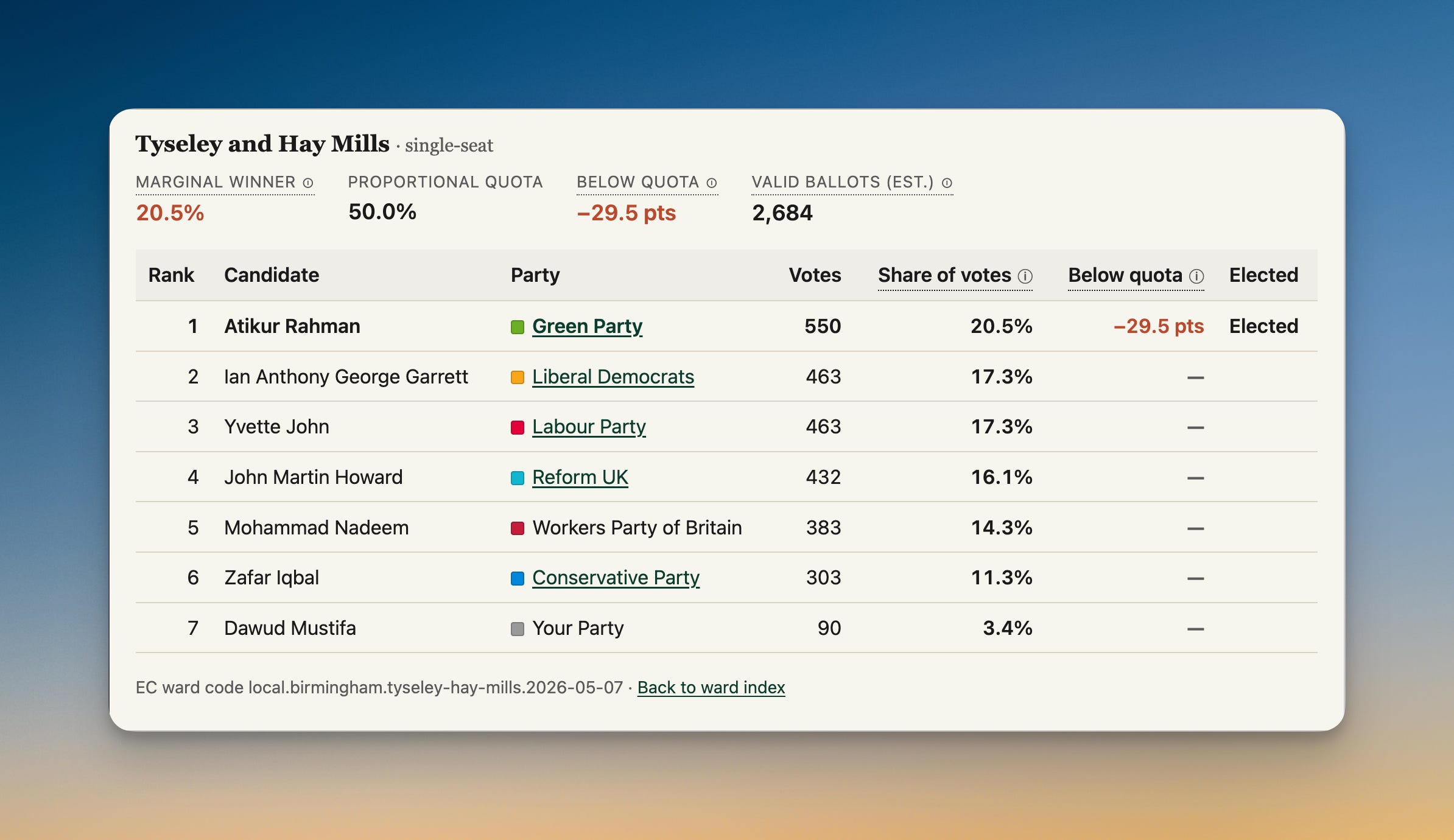
The blueprint works. The building is up. We have been complaining about the shape for several decades, but the architect would, if he could be reached for comment, point out — entirely fairly — that he built what he was asked to build.
The councillor in Tyseley is not the villain. He stood, he campaigned, he won under the rules he was given. He played the game in front of him. The system designed in 1884 to behave exactly this way is the villain. You can hold both thoughts at once. We’re going to.
The audit
For the 2026 cycle I built electionresults.uk — an audit of every council seat in England and Wales, comparing every winner’s vote share against the Droop quota: the mathematical floor that any standard proportional voting method (Single Transferable Vote, D’Hondt, Sainte-Laguë, the regional-list tier of Mixed-Member Proportional) requires to guarantee a seat. The quota is one over the number of seats plus one — 50% in single-member wards, down to 20% in four-seat wards.
Anyone whose vote share fell below the quota for their ward would not have been guaranteed that seat under any of the common proportional alternatives. That makes the count voting-method-neutral by construction. We are not asking you to choose between proportional voting methods. We are showing you how many wins, in May 2026, would have failed under all of them.
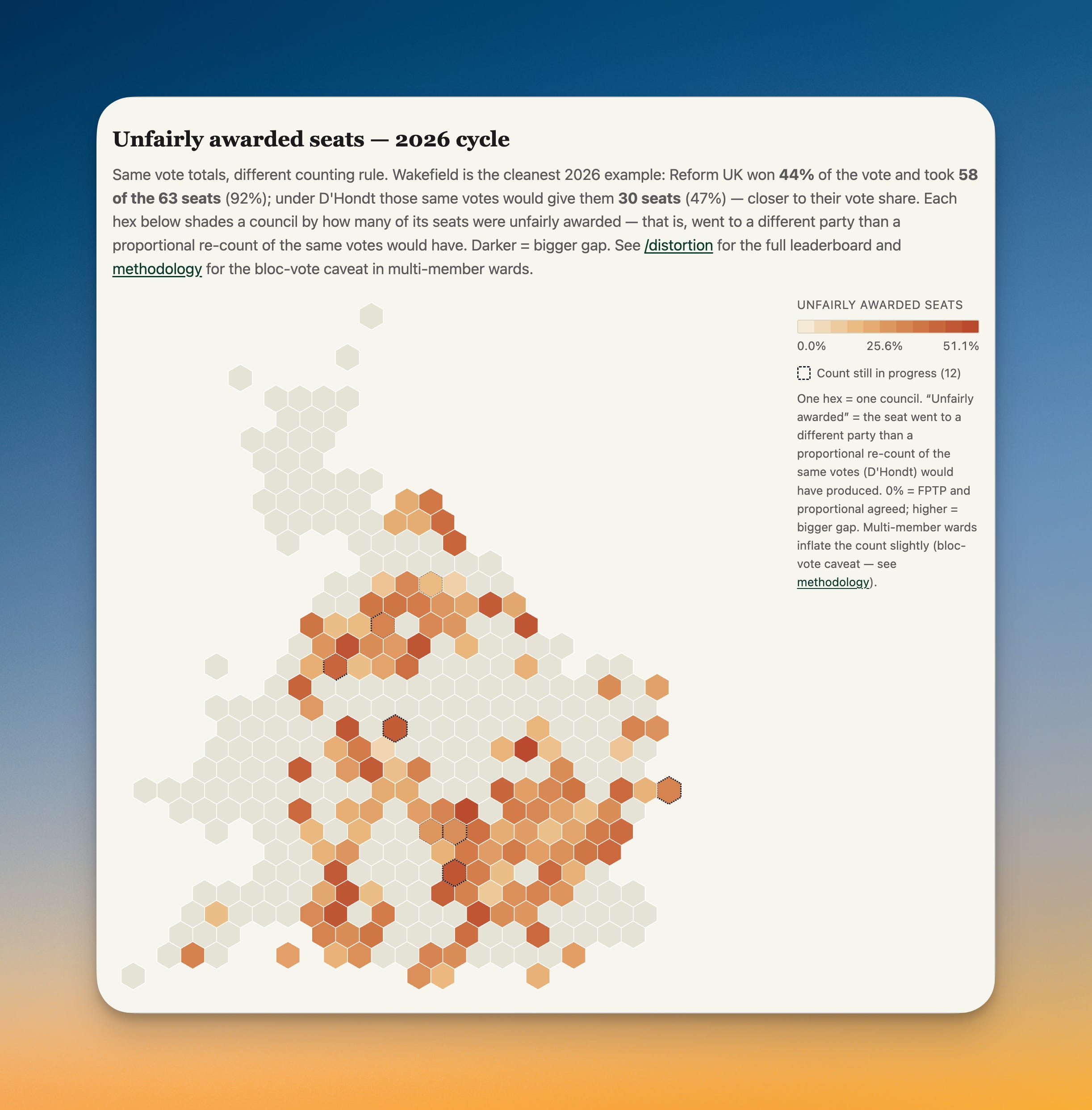
Across 136 councils, 2,943 ward races, and 5,031 seats:
1,593 seats — 31.7% of every seat awarded — went to candidates below quota.
Almost one council seat in three this May went to people who would not have won under any fair count.
That’s the headline. Now look up your own council. The site lets you search by postcode, by ward, by council name. Most readers, I suspect, will find at least one seat in their area in the bin.
Wakefield. Sutton. The two parties that prove the same point.
The aggregate is the story. The cases are the receipts.
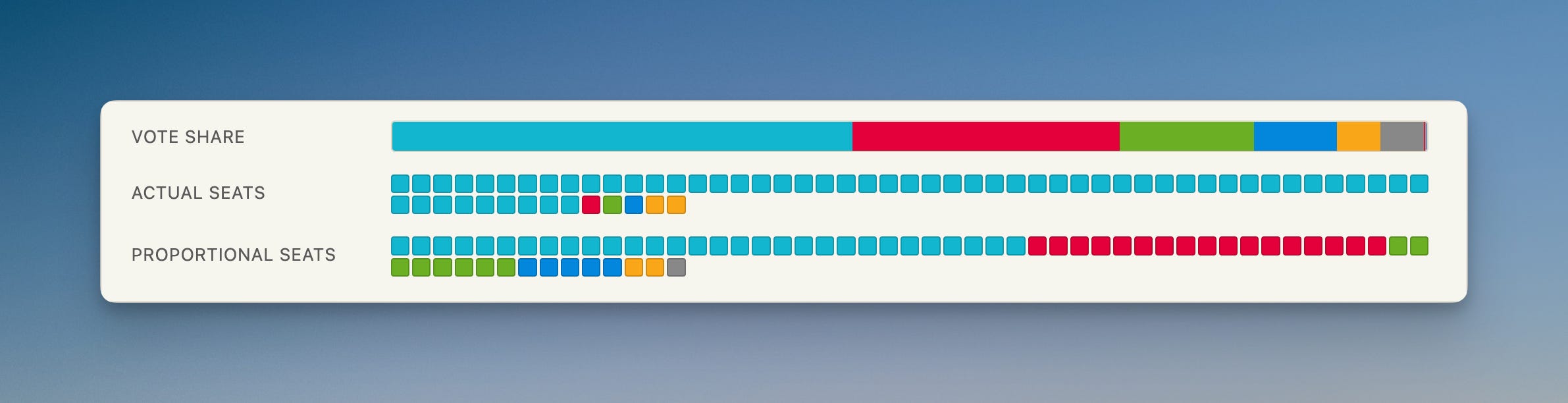
In Wakefield, Reform UK won 44% of the vote and 92% of the seats — 58 of 63. Under proportional allocation they would have won about 30. That is the largest single-council distortion of the cycle. It happens to favour Reform. In 1983 it favoured the Conservatives. In 1997 it favoured Labour. In 2024 it favoured Labour again, and so on through every landslide of the modern era. The system rewards whichever party happens to have its vote efficiently distributed in a given moment. That is what makes the machinery arbitrary, not what makes it partisan.
In Sutton, the Liberal Democrats won 44% of the vote and 93% of the seats — 51 of 55. The Lib Dems are the party whose entire constitutional platform demands the abolition of first past the post and its replacement with proportional representation. They will be the first to tell you they shouldn’t have won 93% of those seats. They are also the people who happen to have benefited from one of the most disproportional council outcomes in England this year.
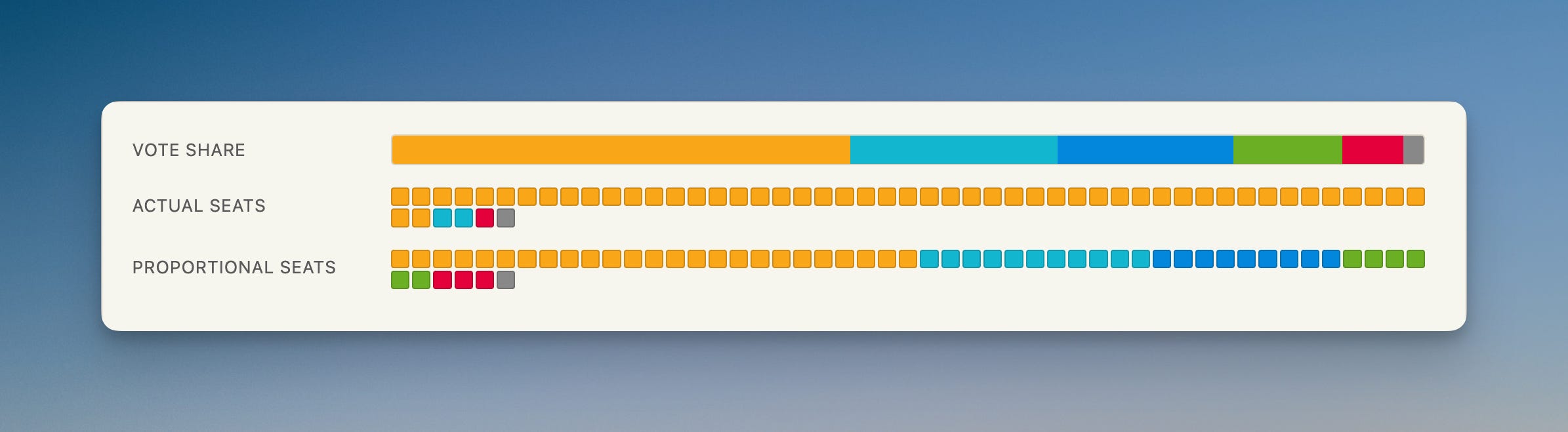
I want you to sit with the symmetry. Two opposite parties; one extreme outcome each; identical machinery; same week. Reform and the Liberal Democrats may agree on almost nothing else, but on the question of whether the Sutton and Wakefield results reflect what voters actually said, they would tell you the same thing: no.
If you needed permission to feel angry about this without feeling partisan, the Lib Dem result in Sutton is your permission slip. They didn’t ask for those seats. They are not entitled to them. They were handed to them by an accident of geography and a 141-year-old blueprint. That is a fact that ought to outrank tribal loyalty, and on this issue it does.
If 1,593 unfair seats sound like the kind of thing that ought to have a petition attached to it — there is one. The National Commission for Electoral Reform petition is the most direct way to put a number on the public demand to fix this. I would normally save the ask for the end. I’m putting it here because Sutton is the moment in this essay where the system-blame frame is at maximum credibility, and the ask deserves to land while you can still feel that.
Each minority winner is a receipt
Think of every below-quota win as a receipt — a small withdrawal made against an account that was opened in private, in 1884, in a room at Lord Salisbury’s London residence in Arlington Street. Three men did the negotiating: Salisbury himself, William Gladstone, and Gladstone’s Cabinet emissary Sir Charles Dilke. They settled the British parliamentary system on single-member single-mark plurality, and quietly abolished the minority-representation clause from the 1867 Reform Act. The Redistribution of Seats Act 1885 followed. We did not vote for it. We were not consulted on it.
The grim joke is that Salisbury, weeks earlier, had publicly argued the opposite case in print. In The National Review in October 1884 he endorsed cumulative voting and warned that single-member equal districts would convert “the right to vote into a right to be out-voted.” The words are his. Then he walked into the room at Arlington Street and signed the country into the system he had just attacked.
Every receipt this May was a withdrawal against that account. 1,593 receipts in one cycle. Multiply across decades and the figure becomes ordinary. That’s the thing about institutional theft: at scale it stops looking like theft. It starts looking like the weather.
Scotland already closed the account
Walk three hundred miles north and the same election week looks completely different.
Scottish councils have used Single Transferable Vote since 2007. Same kinds of councils as in England, same political parties, same general media, same cost of living, same week of election count, same broad political culture. Different ballot. Voters in Scotland rank as many or as few candidates as they wish; their votes transfer when no longer needed; multi-member wards return three or four councillors instead of one.
In the 2026 Scottish council elections, 9.0% of council seats fell below quota. In England and Wales: 19.6% across the same multi-member ward sizes Scotland uses.
Same voters, same parties, same system architecture above and below — and half the rate of unrepresentative outcomes on the side that uses a richer ballot. The Scottish data is not from a thought experiment, an academic model, or a foreign country. It is from people in Glasgow and Edinburgh and Dumfries and Aberdeen casting their votes in the same election cycle as people in Wakefield and Sutton and Birmingham, on the only major piece of British electoral machinery that doesn’t trace back to Salisbury’s pencil note.
Northern Ireland has run STV since 1973. The Welsh Senedd shifted off the Additional Member System and onto closed-list proportional representation for the 2026 election. Every devolved or local UK polity that has been given a richer ballot has kept it. The only place in the UK that has not been given the choice is the place that matters most.
The five things you’ll be told this isn’t
Before the comments fill up, let me concede the strongest sub-claim on each side.
“Proportional representation breaks the constituency link.” Closed-list PR can — that’s why the Welsh Senedd’s 2026 closed lists are already controversial. But Single Transferable Vote, used in Northern Ireland for half a century and in Scotland for nearly two decades, strengthens the link: most voters end up with at least one local representative they actually voted for. The constituency-link defence only works against the worst PR variants.
“PR produces unstable, indecisive government.” Arend Lijphart’s 36-country study found the opposite: proportional democracies match or exceed majoritarian ones on stability and policy performance. Coalitions are the modal form of European parliamentary government, and Norway, Germany, Ireland, Denmark and the Netherlands have run more cohesive long-run policy than majoritarian Britain. The 2024 UK general election, in which 33.7% of the vote produced 63% of the seats, ought to be the final death of the “stable government” defence: that is not stability, that is a brittle artefact of vote distribution that will flip on a small swing.
“Ranked or list ballots are too complicated for British voters.” Northern Ireland has used STV since 1973, Scotland since 2007, the Republic of Ireland since 1922. Spoiled-ballot rates are comparable to plurality elections. The argument that British voters, uniquely, cannot handle a richer ballot is condescending and unsupported.
“PR rewards extremists.” Reform UK got 14.3% of the 2024 general election vote and five seats out of 650; under any common PR system, around ninety. The Greens got 6.7% and four seats; under PR, around forty. First past the post does not suppress fringes; it suppresses anyone whose voters aren’t geographically clustered. That is a different thing.
“The 2011 Alternative Vote referendum settled this.” It didn’t. The 2011 vote was on plain Alternative Vote — not even a proportional system — and the campaign was tied to Nick Clegg’s collapsing personal popularity. I am not a fan of ranked voting methods, and the complexity there is a fair critique, but it’s irrelevant to the question of proportional representation. Polling on actual proportional representation has moved by twenty-five points since then. As of 2025, YouGov has 49% of the public for PR and 26% against — a record gap, with majority support among voters of every major Great-Britain-wide party including Conservative and Reform.
What to do, if you’d like to do something
If you’ve read this far, the system has already lost the argument with you. The remaining question is what you do with the conclusion. Asks, in order of friction:
The lowest-friction action: sign the National Commission for Electoral Reform petition. It takes thirty seconds, it puts a signature against a number, and the number is the most useful single piece of pressure on the political class.
Look up your own council on electionresults.uk. Find the receipts. Share the worst one in your area. The case for reform gets made one specific ward at a time.
If you’re in or near the Labour Party, the political bottleneck on UK electoral reform is not the public, it is Labour’s leadership. The 2022 Labour Conference passed a PR motion that Keir Starmer immediately disowned; PR was absent from the 2024 manifesto, despite Labour going on to benefit from the most disproportional election in modern UK history. The pressure points that work:
write to your MP citing the audit’s specific local results in your constituency
join the Labour Campaign for Electoral Reform or Labour for a New Democracy
raise a motion at your CLP for the next conference cycle
Labour can be moved on this. The 2022 vote proved it. It just needs to be moved by people inside the party.
If you’d like to learn how the alternatives actually work before you commit, proportional.uk is the most honest tour of the options I know how to write.
When does the rest of Britain un-choose?
In Tyseley & Hay Mills, the building works exactly as the architect intended. The receipts are still being printed. They will keep being printed at every cycle until somebody somewhere in Westminster writes a different note than the one Lord Salisbury wrote in private in 1884.
Scotland already wrote it. Northern Ireland wrote it half a century ago. Wales wrote a version of it last month. The political weather has moved. The polling has moved. The audit has the receipts.
It’s not the British public that needs convincing. It’s a Westminster political class that benefits, in alternating turns, from the same machine that elected a councillor on 20.5% of the vote.
We don’t have to keep paying the bill.
Sources for the 2026 audit, including methodology and per-council breakdowns, are at electionresults.uk/methodology.
Disclosure: I built electionresults.uk and proportional.uk, and I volunteer with Citizen Sector, and Make Votes Matter, the UK proportional-representation campaign.
If this essay was useful, the most useful thing you can do with it is forward it to one person who isn’t already convinced. The case for voting reform is made one reader at a time.
There were no ‘ locals’ in Scotland in 2026. It was the Scottish Parliament elections.